Standing on the grassy rim of Mount Aso as sulfurous steam rolled across the plains, I realized how few international travelers ever make it south of Osaka. My two-week trek across Japan’s third-largest island proved that skipping this southwestern paradise leaves the best part of the country unexplored. If you are scouting the best places to visit in Kyushu Japan, you will encounter active volcanoes, ancient cedar forests, riverside hot-spring towns, and world-class culinary hubs untouched by massive tour buses.
Kyushu feels untamed compared to Honshu. Navigating its terrain requires knowing where to slow down, where to board a high-speed bullet train, and where to grab car keys to navigate the misty central highlands.
The Thermal Heart: Kurokawa Onsen and Beppu’s Geothermal Wonders
Kyushu sits squarely on the Pacific Ring of Fire. This geology fuels the highest concentration of geothermal hot springs in Japan, creating two very different hot spring cultures just an hour apart.
Steeping in Edo-Era Seclusion at Kurokawa Onsen
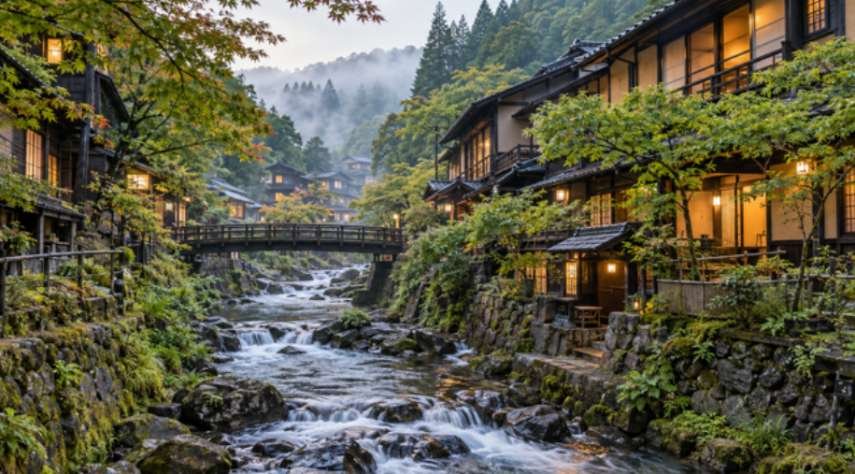
Kurokawa Onsen tucked into the verdant mountains of Kumamoto Prefecture remains my favorite retreat in East Asia. The town banned concrete high-rises, bright neon signs, and loud commercial billboards decades ago. Instead, dirt paths, earthen plaster walls, and rushing mountain streams frame every ryokan.
I bought a wooden nyuto tegata (onsen pass) from the visitor center for about $10 USD. This wooden medallion grants access to outdoor baths (rotenburo) across three different inns. Soaking in an open-air cedar tub along the Tanohara River while bamboo leaves rustle overhead delivers instant calm.
Decoding the Seven Hells of Beppu
Over on the eastern coast, Beppu approaches geothermal water with theatrical energy. Plumes of steam billow continuously between city apartment complexes. The town’s claim to fame rests on the “Seven Hells” (Jigoku), a collection of boiling mineral pools designed for viewing rather than bathing.
Umi Jigoku shines a striking cobalt blue despite simmering at 208°F (98°C), while Chinoike Jigoku bubbles with iron-rich red clay. The regional guide from the Japan National Tourism Organization (JNTO) tracks walking loops through these thermal springs, where local vendors sell eggs hard-boiled directly inside the mineral waters.
Primordial Nature: Mount Aso Caldera and Takachiho Gorge
Central Kyushu hosts landscapes that look lifted from prehistoric times.
Travelers drawn to dramatic volcanic landscapes, deep gorges, and expansive mountain scenery can also explore the top scenic destinations in eastern Taiwan, where rugged terrain and coastal vistas offer a similarly immersive experience.
Ancient caldera collapses and deep basalt gorges make this the most striking terrain in the Japanese archipelago.
Standing on the Rim of Mount Aso’s Nakadake Crater
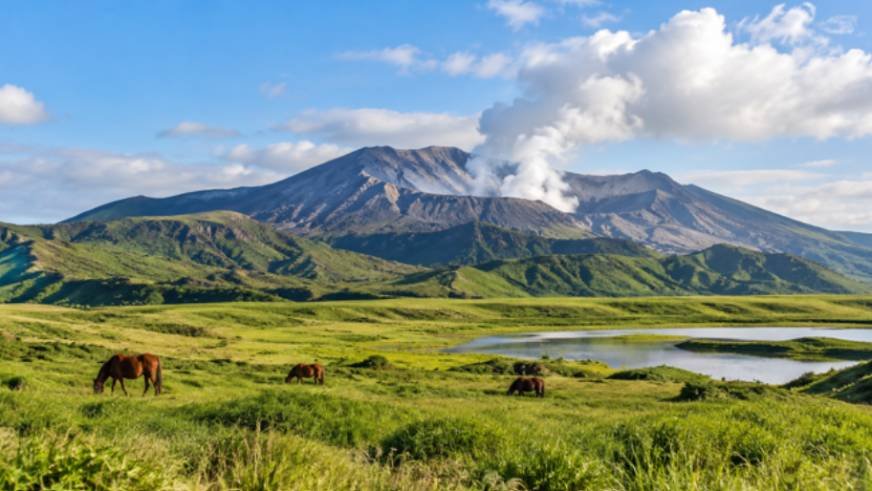
Mount Aso is one of the largest active volcanic calderas on Earth, measuring roughly 15 miles across. Driving up the winding Aso Panorama Line brings you through the lush grasslands of Kusasenri, where semi-wild horses graze against the backdrop of smoking Nakadake Crater.
Volcanic activity shifts quickly here. Before driving up the mountain, monitor real-time gas alerts and safety notices via the Japan Meteorological Agency (JMA) Volcanic Warnings. When alert levels permit approach, standing on the rim looking down into the boiling turquoise acid lake feels like visiting another planet.
Rowing Through Shinto Mythology at Takachiho Gorge
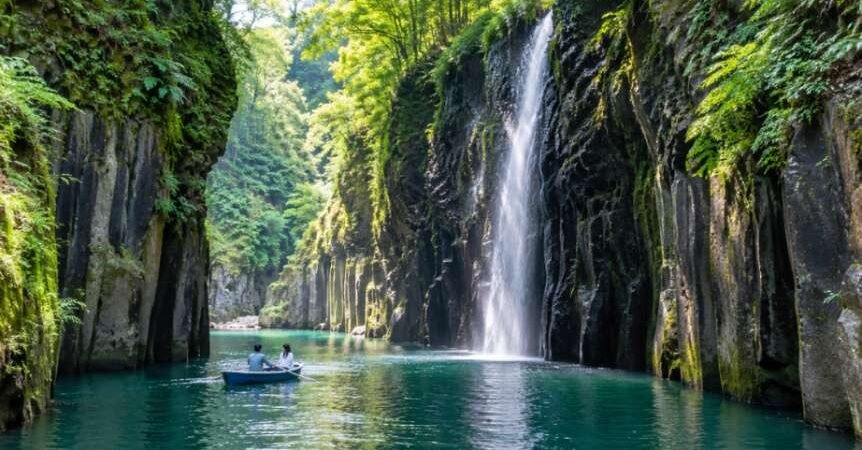
A ninety-minute drive south brings you to Takachiho Gorge in northern Miyazaki Prefecture. The Gokase River sliced through columnar basalt sheets created by ancient Aso lava flows, forming vertical 300-foot volcanic walls.
Renting a wooden rowboat allows you to glide directly beneath Manai Falls, where mountain runoff showers into the teal river below. Legend names Takachiho as the earthly site where the sun goddess Amaterasu emerged from hiding in the Amano Iwato cave, returning sunlight to the world. Walking the paved cliffside trails early in the morning lets you experience the canyon mist before tour groups arrive.
Urban Energy and Harbor Heritage: Fukuoka to Nagasaki
Kyushu balances its volcanic interior with dynamic, historic coastal ports that shaped Japan’s contact with the outside world.
Travelers exploring East Asia may also benefit from comparing Jeju Island vs. Busan, which to visit, as each destination presents a distinctive blend of coastal scenery, cultural heritage, and urban experiences.
For travelers interested in how history has shaped cities across East Asia, exploring historic cities to visit in South Korea offers another perspective on the region’s cultural heritage, architecture, and maritime connections.
Hakata Ramen and Riverside Yatai Culture in Fukuoka
Fukuoka serves as Kyushu’s northern economic anchor. Its culinary scene centers on Hakata tonkotsu ramen—a rich broth simmered from pork bones for over sixteen hours, served with thin, firm noodles.
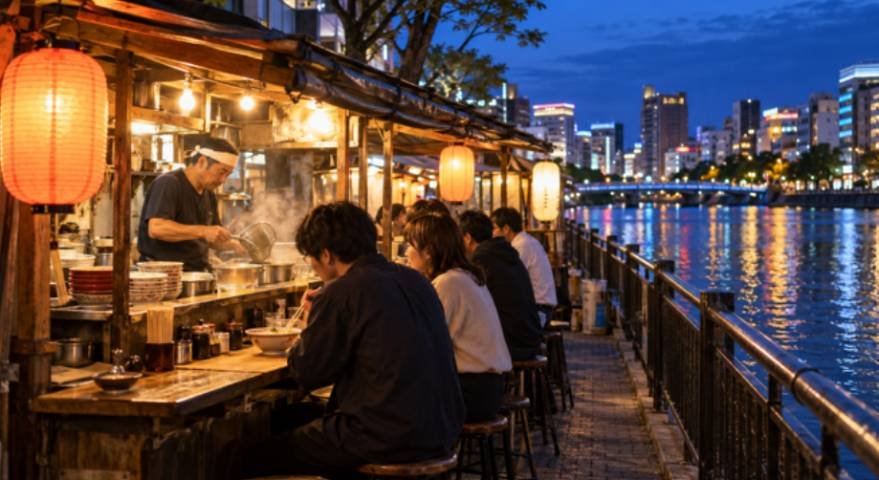
Nightfall brings the famous yatai (open-air street stalls) along the riverbanks of Nakasu Island. Each cart seats around eight to ten patrons shoulder-to-shoulder. Squeezing onto a wooden bench over steaming bowls of ramen, grilled pork belly skewers, and cold beer remains one of the warmest social dining experiences in urban Japan.
Nagasaki’s Layered History and Mount Inasa Views
Nagasaki sits along a dramatic, mountain-ringed harbor. For over two centuries of national isolation (sakoku), the man-made island of Dejima in Nagasaki harbor stood as Japan’s single window to Western trade through Dutch merchants.
The Nagasaki Peace Park and Atomic Bomb Museum offer powerful historical education. In the late afternoon, take the ropeway up Mount Inasa. The summit provides a panoramic night view ranked among the top three in Japan, looking across the glittering harbor bowl.
Kyushu Travel Logistics: Rail Pass vs. Rental Car Cost Reality
Choosing transit across Kyushu depends heavily on group size and your chosen route:
- Solo Travelers and Couples: A regional pass from Kyushu Railway Company (JR Kyushu) offers unbeatable convenience along the coastal perimeter. High-speed Shinkansen trains run from Fukuoka to Kagoshima in just 80 minutes, easily beating highway traffic.
- Groups and Mountain Explorers: For groups of three or four heading to Kurokawa Onsen, Mount Aso, and Takachiho, renting a car in Kumamoto or Fukuoka cuts costs substantially. A standard vehicle rental runs roughly $50 to $70 USD per day.
- Tolls and Electronic Passes: Highway tolls across central Japan add up quickly. Request an Electronic Toll Collection (ETC) card from your rental agency to access flat-rate express passes and automatic weekend discounts.
Stop Dreaming and Head South
Kyushu provides an authentic travel experience that major tourist golden routes cannot match. You can spend the morning staring into an active volcanic crater, the afternoon paddling beneath ancient basalt waterfalls, and the evening eating handmade noodles at a streetside food stall.
Skip the crowded tourist buses in Kyoto and Tokyo. Book a bullet train south to Hakata, map out a loop through the central mountains, and uncover Japan’s geothermal frontier for yourself.
Frequently Asked Questions
1. How many days are ideal to visit Kyushu?
A 7 to 10-day itinerary allows you to balance major cities like Fukuoka and Nagasaki with the central mountain highlights around Mount Aso.
2. Is it easy to get around Kyushu without a car?
High-speed trains connect major cities easily, but reaching rural highlights like Kurokawa Onsen and Takachiho Gorge requires buses or a rental car.
3. When is the best time of year to visit Kyushu?
Spring (late March through May) and autumn (October through November) deliver mild temperatures, clear skies for hiking, and vibrant seasonal foliage.
4. Can tourists drive safely in Kyushu?
Rural roads are well-maintained with clear English signage, though drivers need an International Driving Permit (IDP) before arriving in Japan.